Maximizing the value of your grid connection: How distributed AI unlocks new revenue
Arcadia's mission is to transform energy into a strategic advantage for our customers. Most of the time, that means giving enterprises a single, reliable place to unify their utility data, pay bills, procure energy, and advance sustainability across their portfolio – something that utility companies alone were never going to make easy to navigate.
But transforming energy into a strategic advantage isn’t just about managing what you already have more efficiently. It's about seeing opportunities in your energy footprint that nobody else is looking for.
Every utility bill carries data: what a site pays, when it pays it, and under what tariff. Layer in interval meter data and rate analysis (the inputs to determine what any given usage pattern will cost), and you unlock opportunity. Energy stops being a line item to reconcile and becomes a strategic asset to manage.
That's the lens we bring to every customer relationship. And one of the more interesting places that has taken us is the intersection of energy infrastructure and the AI compute buildout.
An answer to the compute demand problem hiding behind your electricity meter
Demand for AI compute is growing faster than almost anyone modeled two years ago. And while data center developers are racing to bring new capacity online, they are running into constraints: backed-up interconnection queues and multi-year lead times for key electrical equipment. Building our way out of the compute shortage the traditional way – one hyperscale facility at a time – will not keep up with demand.
There's a faster, more economical path sitting inside the electrical infrastructure of buildings across the country. Most commercial and industrial buildings are provisioned with panel capacity well above what they actually use; utilization rates of 30% or lower are common. That gap between peak demand and service capacity is called headroom. It is the power that is already permitted, connected, and energized.
Deploying distributed compute assets from under 20 kW up to several megawatts into that existing headroom sidesteps the interconnection queue. What would take years at a hyperscale data center can happen in a fraction of the time at a building that has the capacity to spare.
In a market where speed to power is the imperative, the fastest gigawatts in America are the ones you can install without permission.
Where Arcadia fits: finding the capacity and making the deal work
Arcadia’s customers represent more than 1 in 5 commercial and industrial meters in the country and are positioned to turn stranded headroom into AI inference capacity and a new revenue line for their business.
Here’s how:
1. Identifying sites with capacity. Arcadia’s utility data platform accesses billing and interval data from every meter in a portfolio to establish historic peak demand and load shape. We then calculate available headroom given service voltage, tariff constraints, and panel capacity. It's the same math a licensed engineer certifies for a permit, run remotely across thousands of sites at once.
2. Assessing project economics. Headroom alone doesn't make a site viable. We evaluate the electricity cost of running an AI compute node at every location. Using the building's interval data and our tariff intelligence, we simulate the compute load stacked on top of the building's existing usage and precisely quantify the incremental electricity cost that results.
3. Project origination. We match qualified sites to the right compute node, financing structure, and installer for their territory and size class, drawing on our partner network of 200+ energy solution providers, energy infrastructure financiers, and leading edge compute providers.
4. Operating and billing. Once a site goes live, Arcadia manages the ongoing energy procurement strategy to ensure cost-effective and risk-managed power supply. We calculate the incremental electricity cost the compute resource adds and facilitate net billing between the parties. The host customer is never out of pocket for hosting the AI node.
A massive hidden revenue opportunity
AI compute may be the highest-value use of a marginal kilowatt-hour in the history of the grid, and now every meter and interconnection can share in that value.
In a recent analysis, we identified more than $100 million in potential lease revenue for a single enterprise customer, across a distributed network of thousands of sites. That's the scale of value that's currently sitting behind meters, and it's a big part of why we think this is one of the more important levers available to enterprise energy leaders as demand for AI infrastructure keeps climbing.
Want to know what value is behind your meters?
Learn More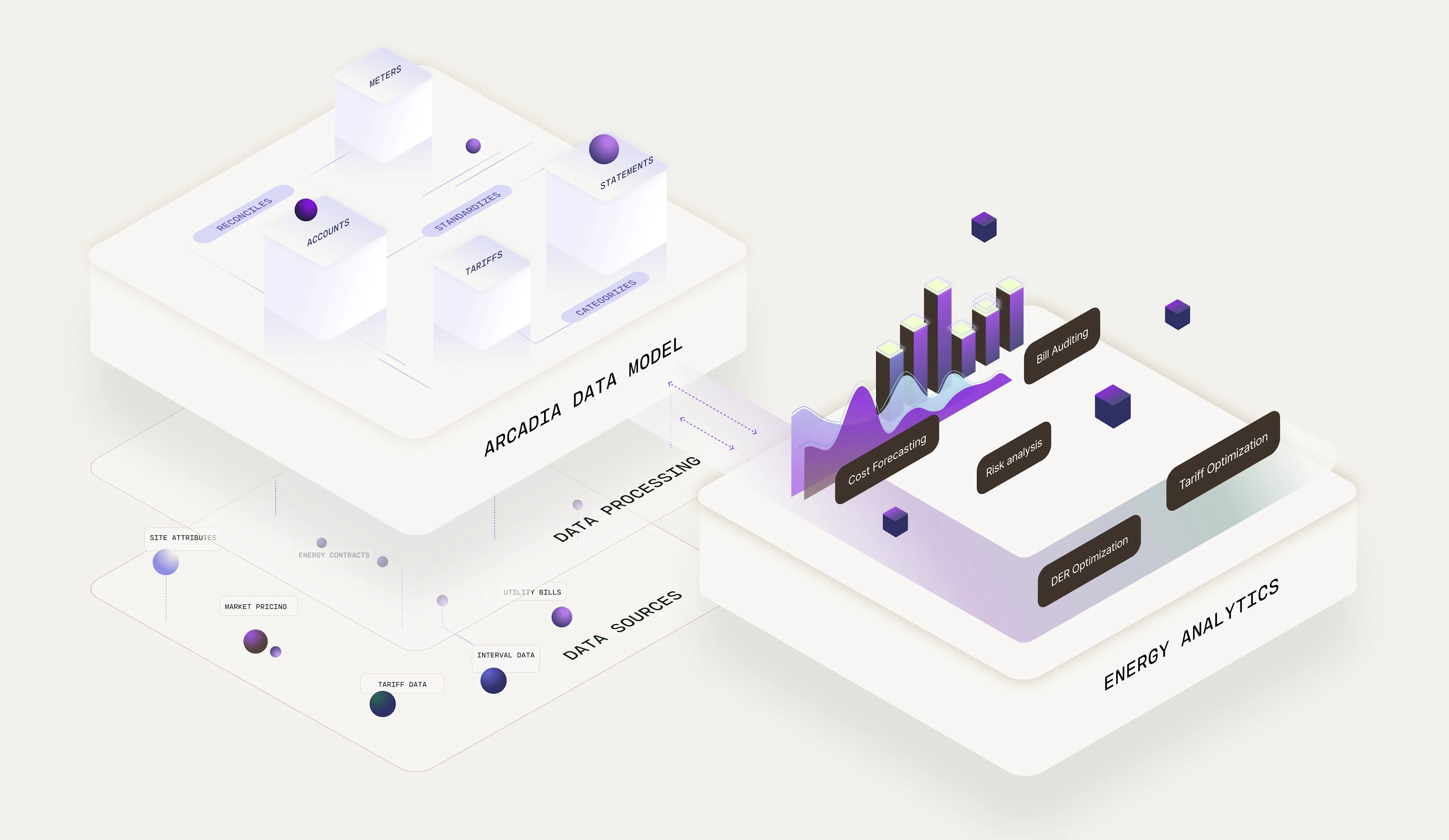


Join our newsletter
Stay updated with our latest insights, industry trends, and expert tips delivered straight to your inbox