Building the energy data foundation data centers need

Data center operators manage facilities worth hundreds of millions of dollars. They invest heavily in redundancy, security, and operational excellence. Yet when it comes to the data underlying their largest variable expense (energy), even sophisticated teams struggle to achieve the verification and accuracy that financial decision-making requires.
Ask data center operators to prove actual PUE performance with validated data across their entire portfolio, confirm optimal utility tariffs at each facility, or comprehensively quantify demand charge impacts across sites. The answer requires pulling data from multiple utility portals, billing systems, and facility management platforms. This data rarely integrates cleanly or validates automatically.
Why data center billing errors compound so quickly
The foundation of energy intelligence is utility data: bills showing what you were charged, and interval data showing when and how much energy you consumed. That foundation is unreliable more often than most operators realize.
Billing errors happen more often than expected. These errors stem from misapplied tariffs, incorrect meter readings, faulty demand charge calculations, or charges continuing on disconnected meters. With so many accounts to manage, these issues multiply the risk of billing mistakes and reflect the complexity of energy management.
The financial stakes are substantial. For data centers operating 24/7/365 at a massive scale, billing errors compound rapidly. When multiplied across megawatts of continuous load, small errors translate to significant financial losses that directly impact cost per compute, competitive pricing power, and operational margins.
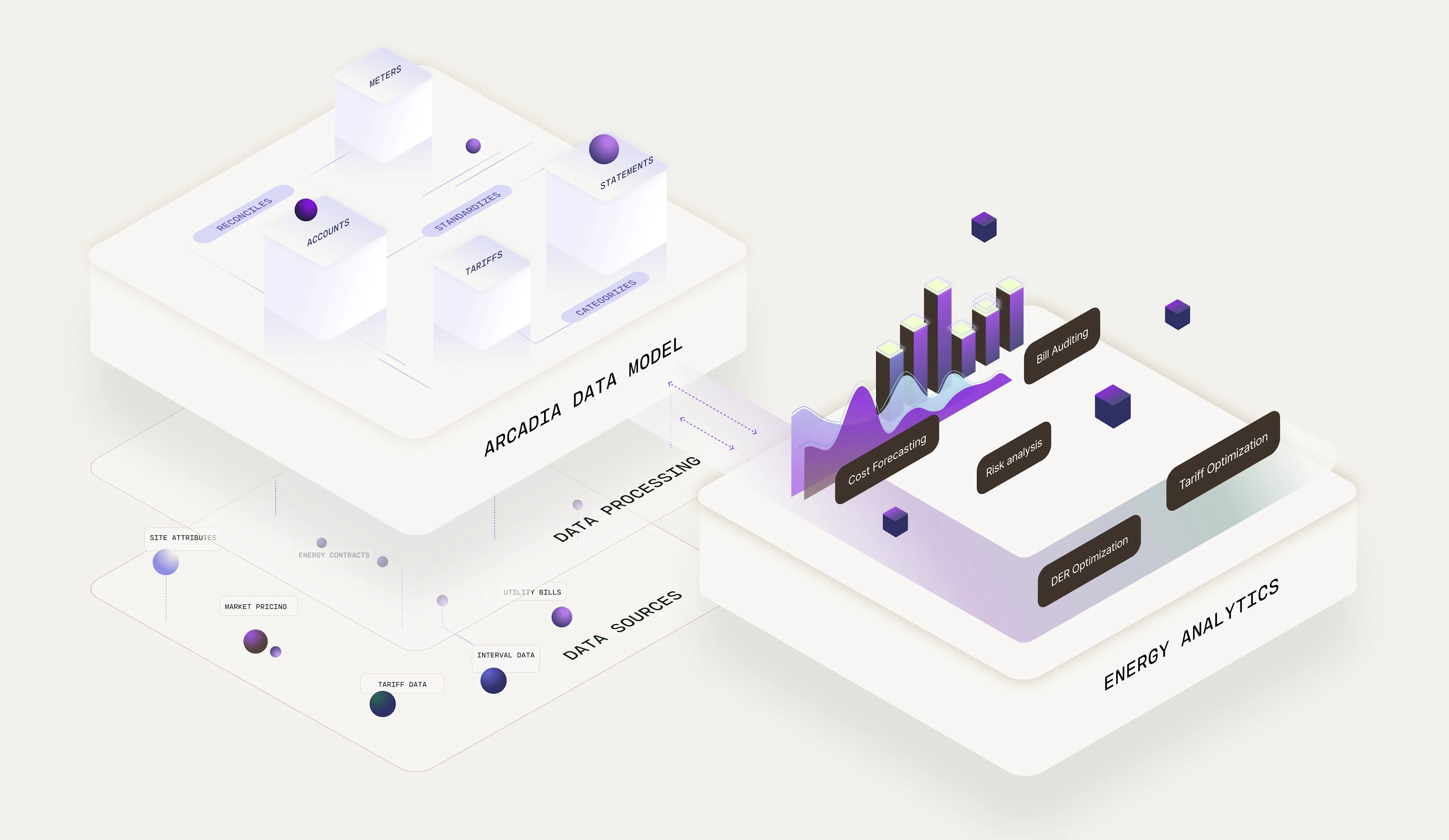
Data center owners and operators face a dual-layer data challenge. First, utility bills arrive as inconsistently formatted PDFs from various utilities, each using different terminology and line-item structures. Systematic analysis, pattern detection, and anomaly identification require standardized bill data. Without it, billing errors can go undetected. Within a few months of using Arcadia to aggregate and standardize utility bills, one hyperscaler identified over $10 million in billing errors.
Second, validating charges and understanding consumption patterns requires interval data. However, raw interval data from utility portals frequently arrives incomplete, with gaps where estimated values replace actual meter reads. These issues typically stem from meter communication failures, utility system errors, or inconsistent formatting across utilities. For those managing multiple accounts, this makes validating peak demand calculations and reconciling bills across the portfolio challenging, even after the high-level bill data has been corrected. Arcadia aggregates interval data alongside bill data, enabling automated reconciliation that validates billed consumption against actual meter reads and flags discrepancies across all charges. At the portfolio scale, this systematic validation becomes the difference between reliable energy data and undetected financial exposure.
The business impact manifests in three areas. First is budget uncertainty. When you cannot trust baseline costs, financial forecasts become unreliable. Second, missed billing errors compound for months before detection. Third, compliance risk as sustainability platforms increasingly require verified consumption data for ESG reporting, driven by regulatory requirements and investor ESG mandates that demand auditable emissions data rather than estimates.
Operators face a choice: invest significant time manually checking bills across dozens or hundreds of accounts, or accept that billing errors will go undetected. For portfolio operators, neither option scales effectively.
Rate complexity across data center markets
Even with accurate utility data, portfolio operators face a second challenge: understanding rate structures and ensuring optimization opportunities aren't missed. For large loads, many utilities offer several rate options, often 3-8 relevant tariffs depending on load characteristics and utility service territory. Optional riders, green tariff programs, and the potential for custom negotiated rates create evaluation requirements that vary by utility and facility characteristics. Meanwhile, rate structures continuously evolve through regulatory proceedings, and smaller facilities in the portfolio may qualify for multiple standard tariff options that require comparative analysis.
Portfolio complexity compounds these challenges. An operator with 30 facilities across 15 different utilities faces numerous possible combinations. Across North America, Arcadia tracks approximately 2,400 utilities with over 75,000 monthly rate updates processed through regulatory proceedings, rate case decisions, and tariff modifications. Monitoring this volume of change across dozens of utilities exceeds the bandwidth of even dedicated energy teams managing procurement, billing, budgeting, and operations. Operating on outdated assumptions means missing optimization opportunities or continuing to pay legacy rates that no longer fit the facility's actual load profile and cost structure.
You can't always build where power is cheapest. Capacity, connectivity, and customer requirements often dictate site selection. Arcadia's tariff intelligence reveals commercial electricity rates from 3.7¢/kWh in the Pacific Northwest to 15.3¢/kWh in California, and demand charges from $10/kw-month in Birmingham, AL to $22.20/kW-month in Ashburn, VA; over a 2x difference. For a 25 MW facility with an 80% load factor, that's approximately $222,500 in average monthly demand charges in Birmingham, AL versus $457,000 in average monthly demand charges in Northern Virginia. Annually, that’s a difference of over $3.02 million. Whether expanding into new markets or optimizing existing sites in higher-cost regions, comprehensive tariff intelligence helps manage what can be controlled: evaluate tariff options, benchmark across your portfolio, model scenarios across utilities and jurisdictions, and forecast budgets based on actual rate structures. This transforms rate complexity from a constraint into actionable intelligence.
A data center that hasn’t evaluated rate options in the past few years may still be on a standard industrial tariff, even though its 24/7 baseload profile could qualify for rates designed for consistent loads. AI data centers, by contrast, often have highly variable, bursty workloads or very high-density racks, which create different opportunities and risks for rate optimization. These opportunities remain invisible without systematic tariff intelligence, representing millions in unrealized savings.
What reliable and accurate data unlocks
Validated utility data combined with comprehensive tariff intelligence provides the foundation that strategic energy management requires. Without it, procurement decisions rely on incomplete bills, expansion planning uses outdated tariff assumptions, and optimization opportunities remain hidden in undetected errors.
Data center portfolios, whether colocation providers, hyperscale operators, or enterprise facilities, reach a threshold where manual energy management breaks down. Even with 10-15 facilities, operators face dozens of utility accounts, hundreds of monthly bills, and changing tariff structures across multiple utilities. With energy representing a major operating expense, manual processes cannot sustain the continuous validation and accuracy that strategic planning demands as portfolios scale.
Reliable data is essential, but it's only the foundation. In our next article, we'll explore what comes next: using validated data and tariff intelligence to negotiate custom rates with utilities and strategically apply them across portfolio forecasting and procurement decisions.

Optimize your energy management strategy end-to-end. Contact our team to learn more about how Arcadia can support your enterprise energy needs.
Contact us

Join our newsletter
Stay updated with our latest insights, industry trends, and expert tips delivered straight to your inbox