How to optimize costs and forecasting across data center portfolios

Data center energy economics are shaped by critical decisions: where to build, what rates to negotiate, and how to manage portfolios at scale. Each choice carries lasting financial consequences and relies on validated utility data and comprehensive tariff intelligence.
Our previous blog explored why this foundation matters: how billing errors compound, why rate complexity exceeds manual analysis, and the insights reliable data can unlock. This post shows how operators leverage that intelligence across site selection, rate negotiation, and portfolio operations.
Integrated Energy Intelligence: The enabling infrastructure
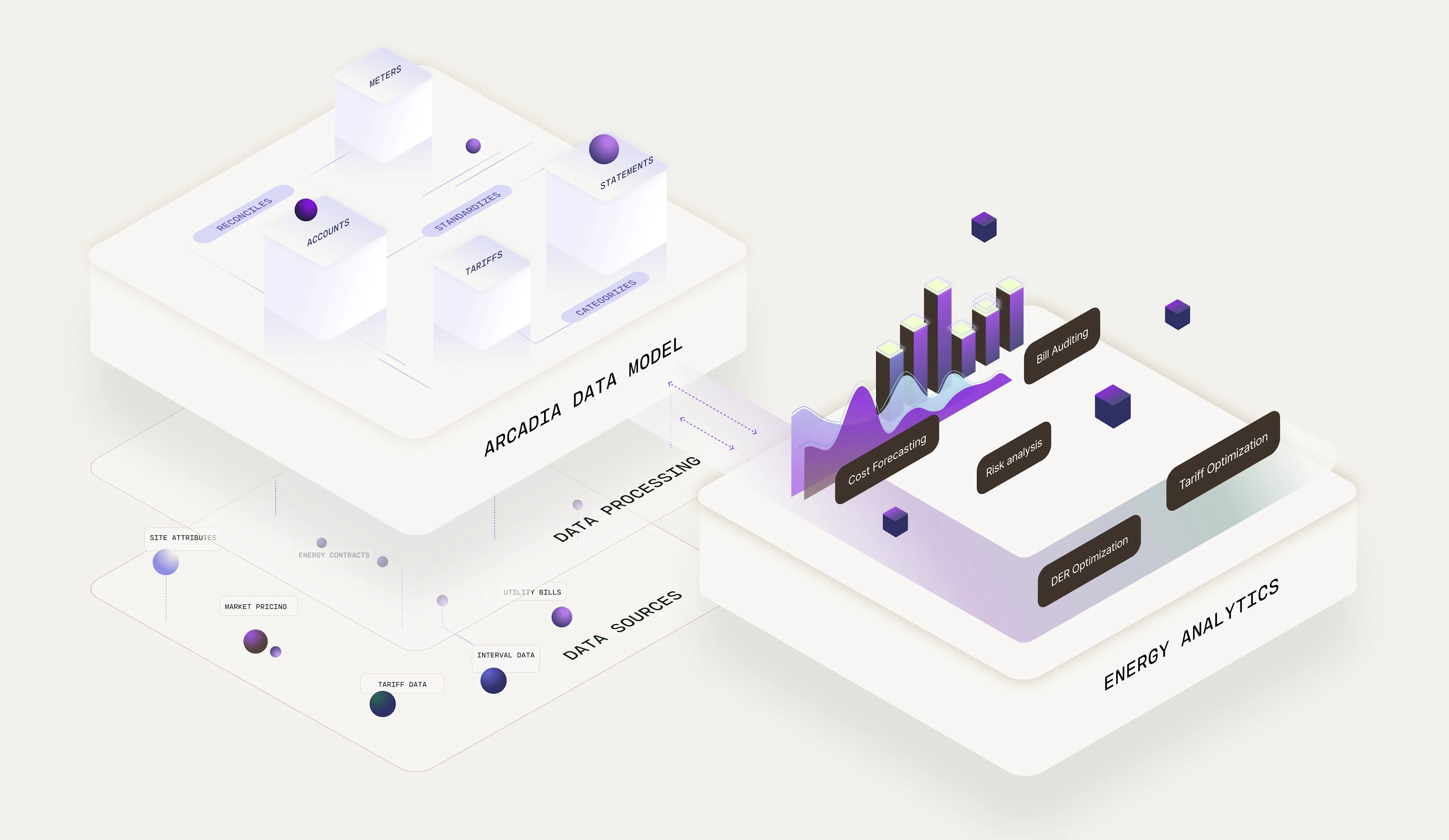
What makes this possible at scale? A comprehensive, continuously updated energy data infrastructure. Arcadia's Plug aggregates, normalizes, and standardizes utility and interval consumption data across portfolios. Signal, a high-accuracy bill simulation engine and tariff database, models costs using over 30,000 tariffs covering 97% of North American utilities—approximately 2,400 utility territories with 75,000 monthly rate updates processed as utilities file changes.
Together, these capabilities form an integrated approach that applies interval data to detailed tariff structures, enabling cost modeling, bill validation, and scenario analysis for portfolio operational and financial decisions. This combination delivers insights beyond regional averages or manual spreadsheets, giving operators tariff-level precision. Organizations managing energy analytics in-house can leverage these tools directly, while others can access Arcadia’s advisory services as an extension of their teams.
The following sections demonstrate application across three critical decisions.
Market Evaluation: Using energy intelligence for site selection
Data centers can't always build where power is cheapest—capacity, connectivity, and latency constrain options. Organizations evaluating expansion need fully-loaded costs across all relevant tariffs in each candidate market. Location matters: Arcadia's 2026 Commercial Electricity Rate Report shows effective rates varying by up to 70% between neighboring utility territories. Using specific tariffs and actual load profiles, operators can compare rate structures from individual sites to multi-site portfolio analyses.
Rate Negotiation & Strategy: Turning data into leverage
For loads typically above 25 MW, or portfolio operators with significant aggregate demand, utilities negotiate custom rates that can reduce fully-loaded costs. The advantage belongs to operators who understand their costs under standard tariffs and are prepared to demonstrate where custom terms create mutual value.
Establishing your baseline
The first step is analyzing your load under applicable standard tariffs. Applying historical load data—consumption patterns, peak demand, and load factor—to standard rate structures reveals what you'd pay without negotiation. For portfolio operators, aggregated data strengthens this baseline analysis. This baseline becomes your starting point.
Evaluating custom rate proposals
When utilities propose custom rates, Signal enables modeling those proposals as private custom tariffs, allowing side-by-side comparison of proposed custom rates against public standard tariffs with historical load patterns. This shows how proposed terms perform under real operating conditions. Custom rates often look attractive on paper but include commitments—minimum bills, contract duration, demand penalties—that require scenario analysis against actual consumption patterns. Modeling the utility's proposal against standard tariff alternatives and various operating scenarios determines whether to accept or continue negotiating.
Tailoring strategy to market structure
Market structure shapes how operators establish a baseline and negotiate rates. In regulated markets, operators analyze load under standard tariffs, then negotiate custom terms with the utility. In deregulated markets, calculating the retail supply rate provides a comparable baseline for evaluating third-party suppliers. In our next blog, we’ll dive deeper into procurement strategies in these markets.
After securing a favorable tariff rate, whether a utility or third-party contract, it becomes an operational asset. Signal allows operators to configure a negotiated rate as a private custom tariff, translating contract terms into a usable rate structure. This ensures the agreed-upon rate is accurately codified and ready to be used in day-to-day energy management.
Controlling Energy Spend: Oversight, forecasting, and cost management
With the tariff rate configured in Signal, operators can apply it to recurring energy management activities, including: bill validation, energy cost forecasting that informs budgeting, and periodic reassessment of rate alignment. When these practices are executed consistently across data center sites, organizations gain visibility into energy cost drivers, reduces unexpected variance, and strengthens portfolio-level financial planning.
Validating billing accuracy
Signal’s rate modeling calculates expected charges under standard or custom tariffs using interval data. Comparing these modeled charges to utility bills either confirms accurate billing or highlights discrepancies—such as incorrect tariff application or undisclosed rate changes—allowing operators to investigate and resolve issues efficiently.
Forecasting costs and budget impact
Signal’s scenario modeling allows operators to select future date ranges, input projected load data, and model costs under current rate structures. Arcadia incorporates Power Usage Effectiveness (PUE) to translate utility costs into true cost per compute unit, ensuring projections reflect actual infrastructure economics.
Data center organizations planning significant growth—such as scaling from 50 MW to 200 MW over 36 months—can model multiple scenarios, including accelerated buildout, delayed expansion, or partial deployment. By applying historical interval data to current standard or custom tariffs, Signal delivers tariff-level precision for forecasts, revealing cost implications under various operating conditions and load trajectories that spreadsheet-based estimates cannot match.
Signal also models tariff-specific complexities like coincident peak demand charges (4CP in ERCOT, 5CP in PJM) and curtailment-based tariffs that credit load reduction during grid events. Facilities with flexible loads, such as AI training workloads or other curtailable operations, can uncover additional optimization opportunities.

Proactively managing costs, risks, and tariff opportunities
As operations evolve, rate optimization requires monitoring trigger points: facilities exceeding their tariff class, shifting load profiles, or new tariffs becoming available. Using Plug’s interval data and Signal’s tariff database, operators can evaluate current rates against emerging alternatives and model proposed tariffs before they take effect, assessing potential benefits and risks for each facility. This approach not only identifies cost-saving opportunities across sites but also ensures facilities are on the correct tariff and that risk exposure is minimized.
While site selection analysis, rate negotiation, and portfolio forecasting each deliver measurable value independently, the compounding benefit comes from consistent application across all three. Insights from one facility's rate negotiation inform strategy at other sites. Portfolio-wide visibility reveals patterns that facility-by-facility analysis misses. Scenario modeling for one expansion becomes a reusable framework for subsequent growth decisions.
Energy Intelligence: Driving portfolio-level financial & operational performance
Applied systematically across site selection, negotiation, and operations, energy intelligence creates measurable portfolio impact. Arcadia's integrated approach addresses the compounding risks of billing discrepancies, tariff misapplication, and forecast inaccuracy, helping operators make decisions that directly affect operational margins and cost per compute.
Energy strategy extends beyond rates to procurement decisions: evaluating third-party suppliers, renewable PPAs, and demand response programs. These decisions build on the same foundation of validated utility data and comprehensive tariff intelligence.
In our next blog post, we’ll explore how data centers navigate energy procurement. Extending beyond tariff intelligence, Arcadia leverages deep market intelligence and independent advisory expertise to help operators identify viable energy supply options, assess the impact of different generators on sustainability and energy budgets, and balance costs and risks aligned with business priorities. With a framework for strategic procurement planning and the flexibility to evaluate opportunities across retail, renewable, and regulated markets, Arcadia provides finance and operations teams the visibility required to forecast accurately, manage structural cost exposure, and make disciplined portfolio-level capital and procurement decisions.

Optimize your energy management strategy end-to-end. Contact our team to learn more about how Arcadia can support your enterprise energy needs.
Contact us

Join our newsletter
Stay updated with our latest insights, industry trends, and expert tips delivered straight to your inbox